
Shenzhen and the AI Short-Drama Boom
How China built a content machine that ships a new drama every 36 seconds
In October 2025, about 5,300 AI-generated drama titles were available to Chinese viewers. Five months later, in March 2026, that pool had reached 133,000 on-air titles — plus another 47,000 released in that single month. By July 2026, a new AI drama was going live every 36 seconds.
That is not a growth curve. It is a phase change.
1. A market that grew 138% in a single year
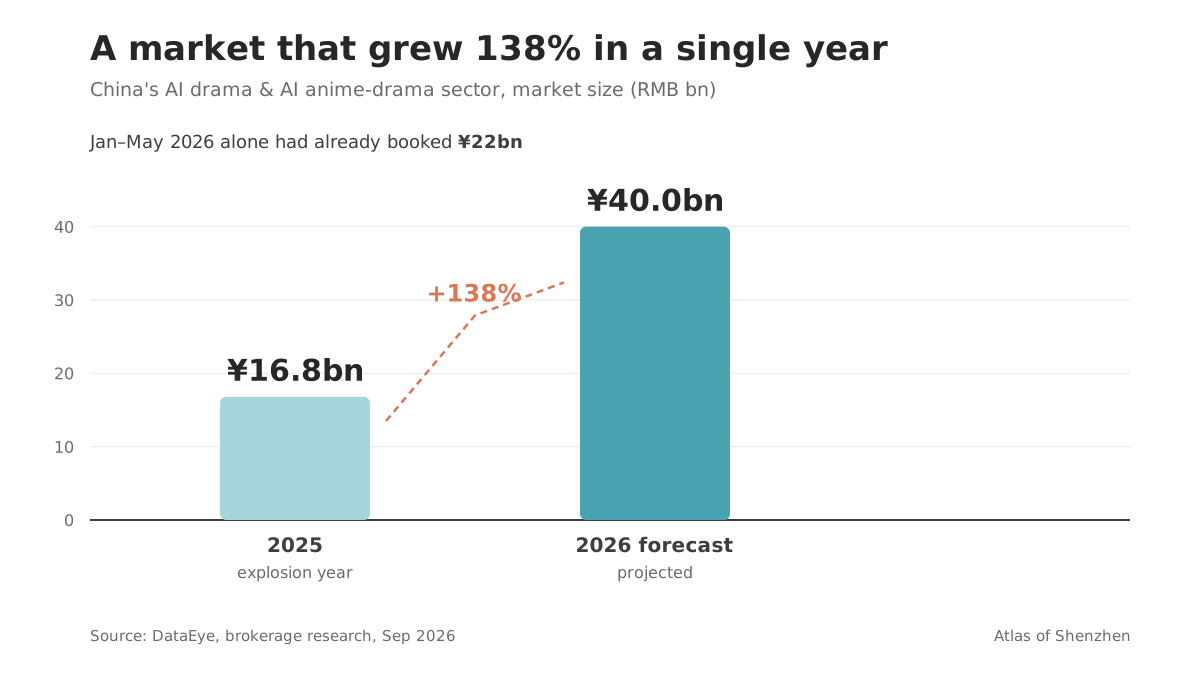
China's AI drama and AI anime-drama sector was worth roughly ¥16.8 billion in 2025 — the year the industry now calls the "explosion year." For 2026, forecasters expect about ¥40 billion, a year-on-year increase of 138%. Between January and May 2026 alone, the market had already booked ¥22 billion.
Zoom out and the picture is larger still. Combine traditional micro-dramas with AI drama and anime-drama, and the Chinese market is projected to break ¥121 billion in 2026, with the AI segment contributing more than ¥40 billion of it. In the first half of 2026, the number of Chinese users watching AI short dramas passed 600 million.
The international story mirrors the domestic one, roughly one cycle behind. Overseas micro-drama revenue was estimated at about $4 billion in 2025 and is expected to reach $6 billion in 2026 — an upgrade from the earlier $5 billion forecast. In the first half of 2026, overseas short-drama apps collected roughly $1.27 billion and reached about 258 million monthly active users. In the first quarter, global short-drama app downloads hit 850 million, up about 140% year on year.
2. 851 million viewers, and the arithmetic of attention
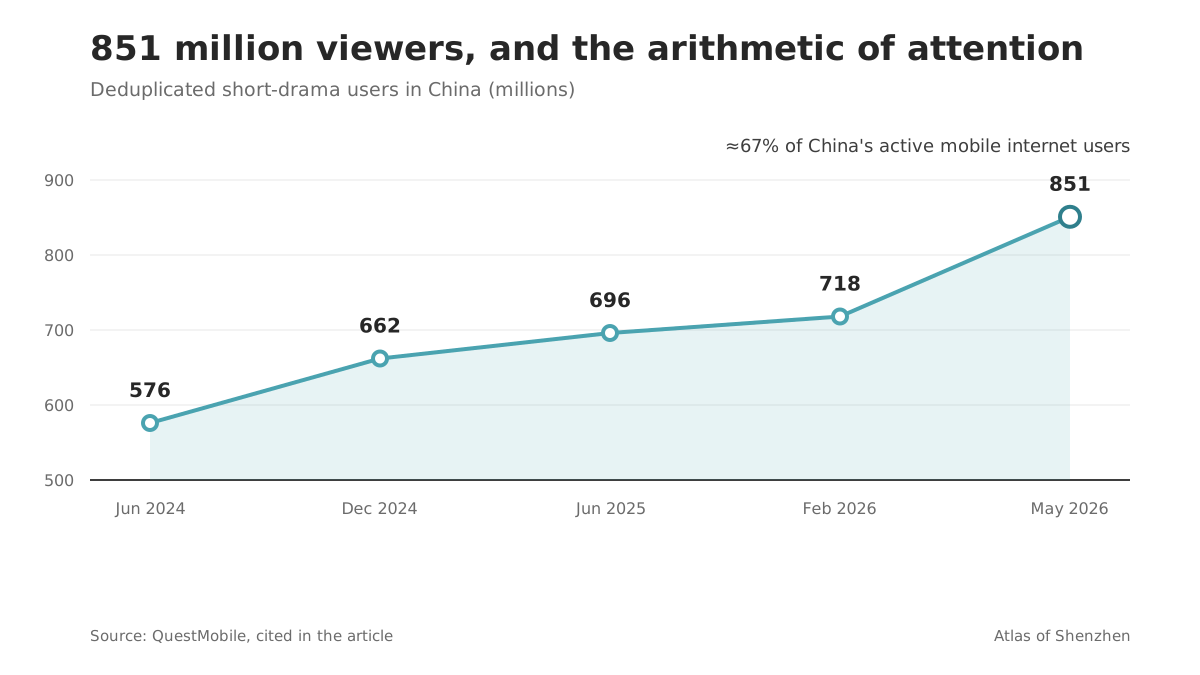
The audience base is no longer a niche. Deduplicated short-drama users in China grew from 576 million in June 2024 to 662 million in December 2024, 696 million in June 2025, 718 million in February 2026, and 851 million by May 2026. That is roughly 67% of China's active mobile internet population — about 2.8 times the monthly active users of a single leading long-video platform.
The more telling number is time. Average monthly per-user time inside short-drama apps rose from 10.8 hours in June 2024 to 26.9 hours in May 2026, overtaking traditional online video platforms. Distribution is split across 402 million app users, 508 million WeChat mini-program users, and 14 million Douyin mini-program users.
And the audience is young. Among AI short-drama interest users, the 25–30 and 31–35 brackets show the highest engagement index (TGI 128 and 132), while traditional short drama skews to viewers over 51. Research cited by Guosen Securities puts anime-drama core users at 24–30, with men accounting for roughly 86%. On spending, 51.1% of AI short-drama interest users sit in the ¥1,000–1,999 monthly online spending band.
3. Supply: more than 95% of everything new is AI
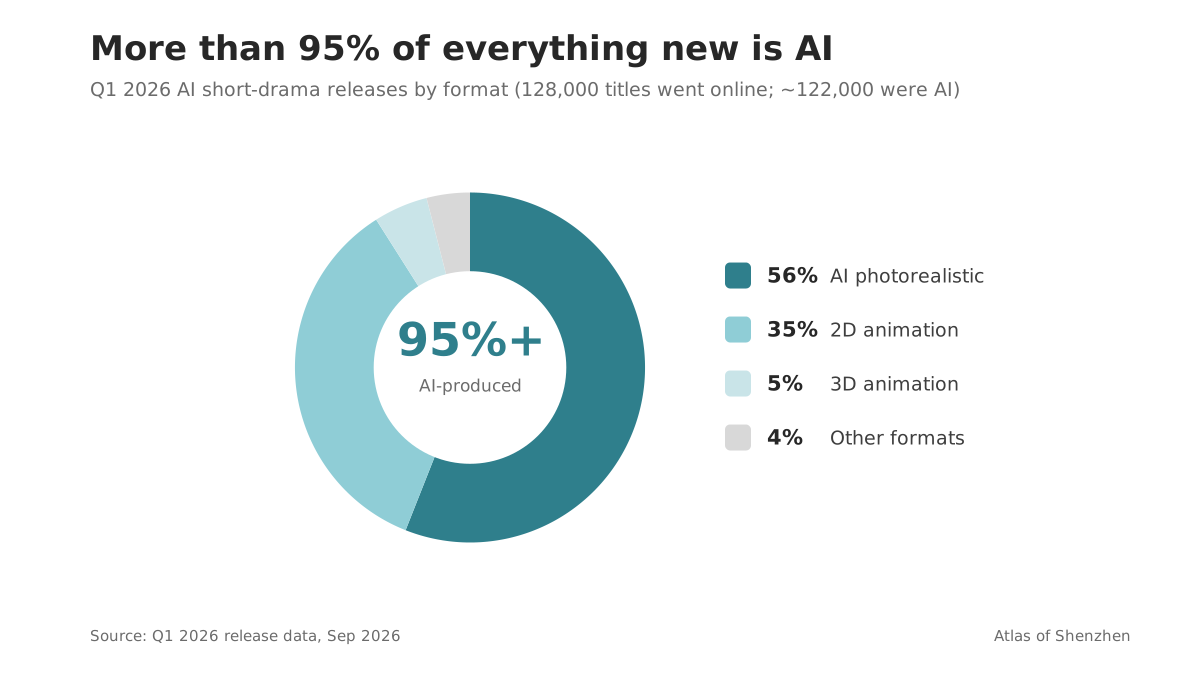
In the first quarter of 2026, roughly 128,000 short dramas went online in China. About 122,000 of them — more than 95% — were AI productions. New releases in the quarter exceeded 100,000 titles, and AI photorealistic drama accounted for about 56%, 2D animation 35%, 3D animation 5%, and other formats 4%.
Genre concentration is extreme. "Comeback" stories — the underdog who returns to dominate — led both the on-air chart with more than 9,000 titles and the new-release chart, contributing over 75% of new-release viewership. Among the top 100 anime dramas, 52 were comeback stories. Fantasy, urban slice-of-life, rebirth, family ethics, and rural themes filled the second tier, and ancient settings outperformed modern ones in total plays.
Hit titles show unusual longevity. One comeback drama has passed 4.1 billion plays on Douyin and has already run to an eighth season — a franchise cadence closer to television than to the throwaway economics the format was built on.
4. The cost collapse
The production engine improved on a compressed timeline. Midjourney V5, in March 2023, delivered photographic realism. Pika 1.0, in November 2023, proved lightweight diffusion video. OpenAI's Sora appeared in February 2024. Kuaishou's Kling 1.0, in August 2024, was the first publicly available DiT-architecture video model; Kling 2.0 followed in April 2025, and Sora 2 in September 2025.
Then the pace accelerated. ByteDance released Seedance 2.0 on 12 February 2026, adding multimodal text-image-audio-video input, character anchoring, and shot-to-shot consistency — the point at which AI video could carry a complete story. Kling 3.0 arrived the same month, consolidating understanding, generation, and editing into a single workflow. SkyReels V4 shipped in March, Alibaba's HappyHorse in April, MiniMax H3 in July, and Alibaba's Wan 3.0 in August, stretching single-shot generation to 30 seconds.
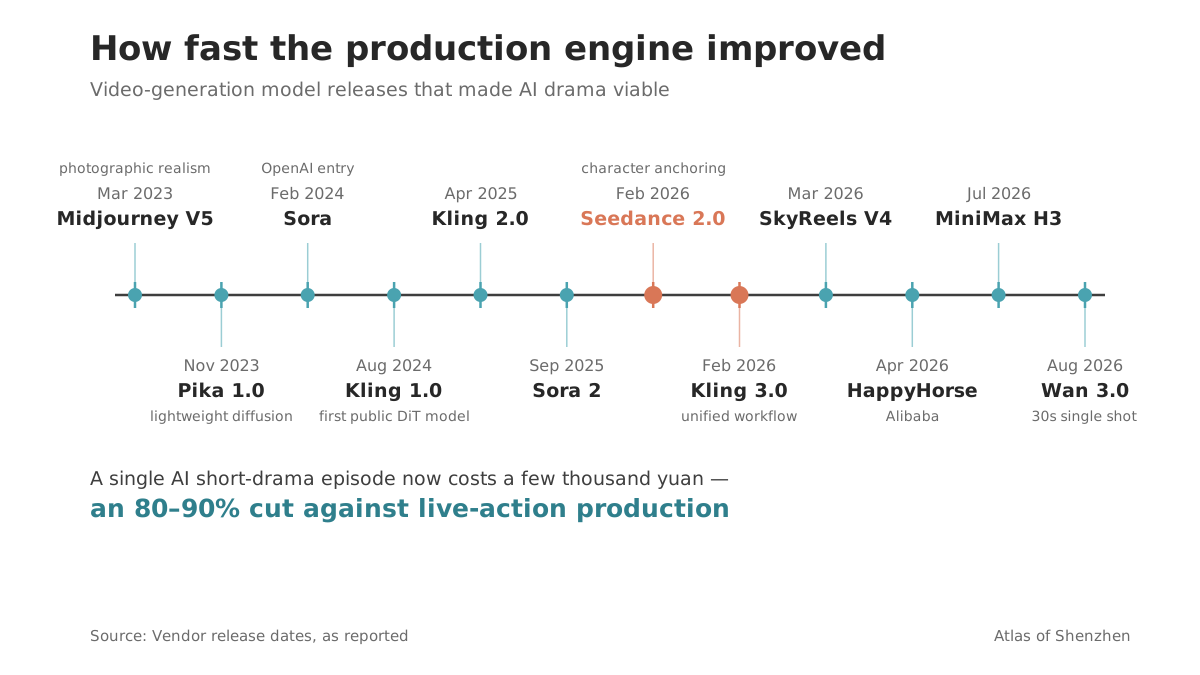
The economic consequence is the real story. With models like Seedance 2.0, a single AI short-drama episode can cost a few thousand yuan, and an AI anime episode a few hundred — an 80% to 90% reduction against live-action production. Content became cheap enough to test.
5. The 1% problem
Cheapness has a shadow. In the first half of 2026, 221,900 new AI short dramas appeared on Douyin. Only 1,055 passed 100 million plays. The industry's hit rate is under 1% — roughly one breakout per thousand titles.
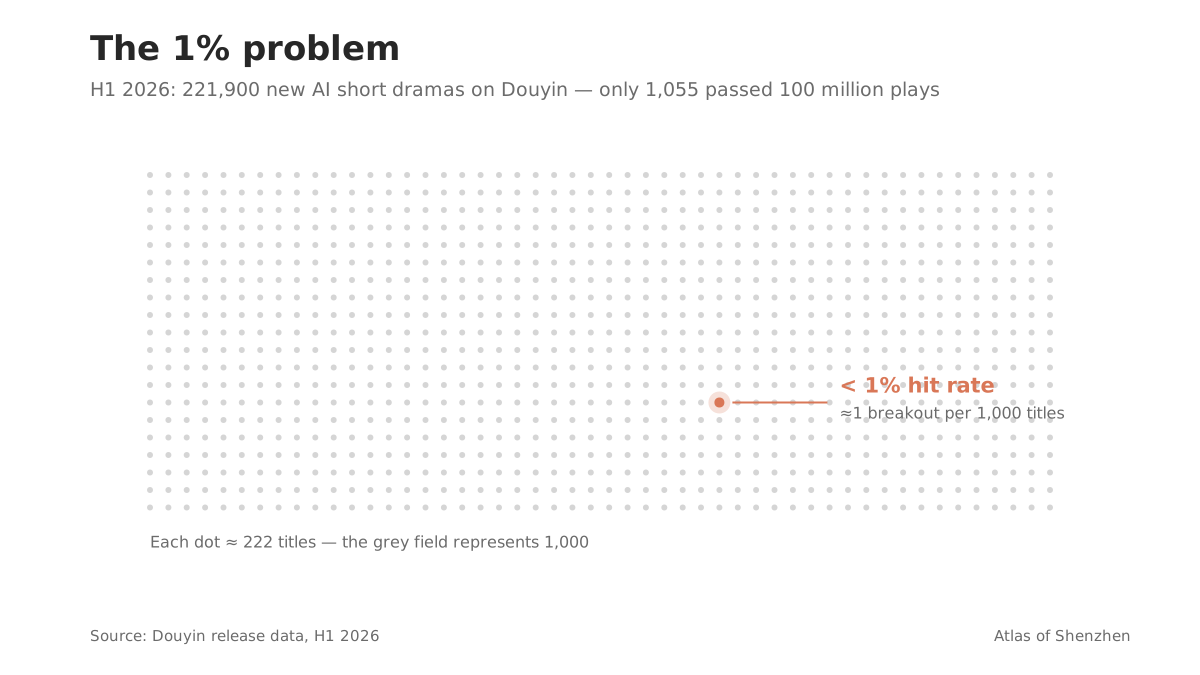
That ratio explains the industry's new operating logic. Producers no longer bet a full season on a script. They publish a 10-episode test block, read the data, and continue only what the audience rewards. Distribution has shifted from project-based gambling to a data funnel. Compact teams now run portfolio-style selection across dozens of concurrent titles, and platforms have compressed the distance between release and verdict to days.
6. Two ways to monetise
Two models now run in parallel. IAA — ad-supported free content — is represented by Hongguo Short Drama, which reached 168 million daily active users in July 2026, up about 107% year on year and more than the combined daily actives of iQiyi, Youku, Tencent Video, and Mango TV. IAAP — in-app purchase, membership, and pay-per-unlock — is the model behind most overseas platforms, with revenue sharing between platform and producer.
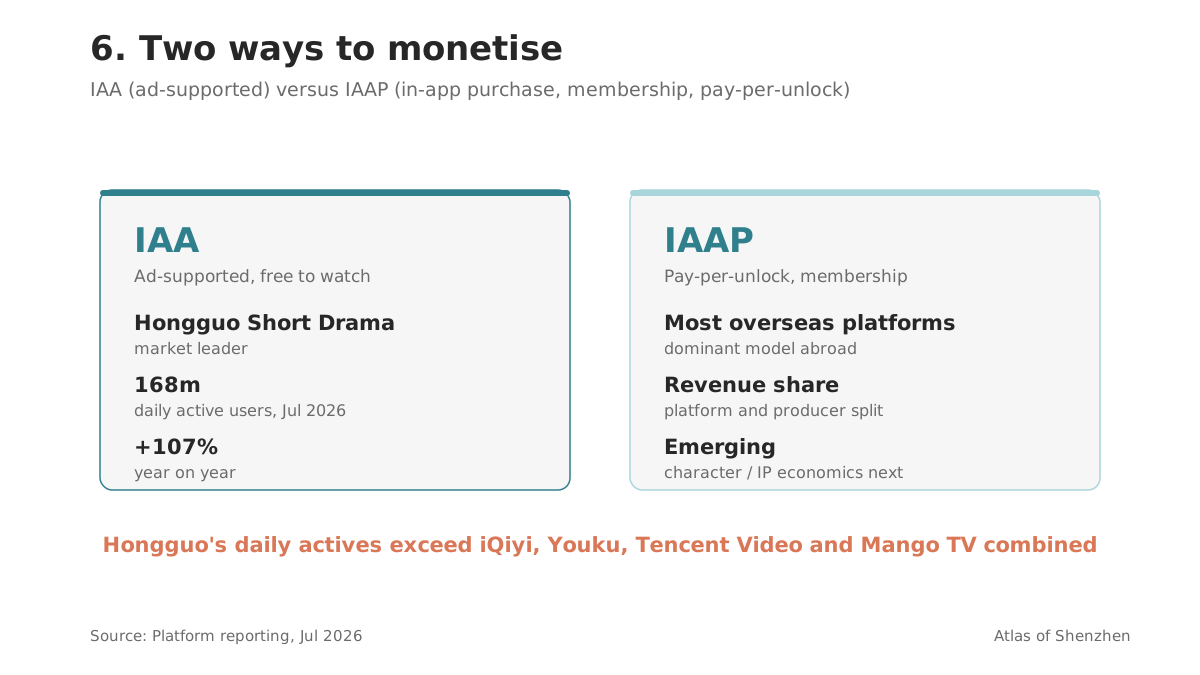
The next monetisation unit is unlikely to be a series. It will be a character.
7. Four platforms, four maps
Overseas, four Chinese-born platforms have taken different positions. ReelShort, from Chinese Online and CMS, leads with premium localisation: the United States contributes 52% of its overseas marketing spend and more than 60% of revenue, with Brazil, Mexico, Canada, and the United Kingdom behind it — and ReelShort ranks first in the US on downloads, in-app purchase revenue, and monthly active users simultaneously.
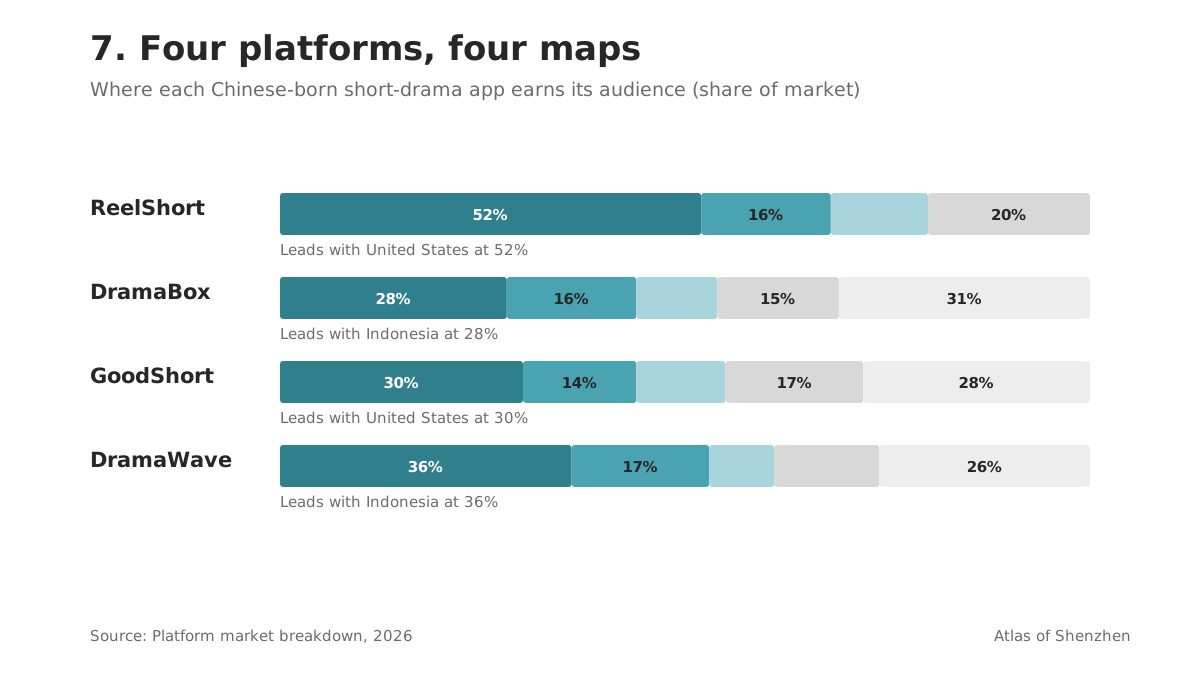
DramaBox, from Dianzhong Technology, scales translated content across regions: Indonesia 28%, the United States 16%, Thailand 10%, Brazil 8%, Vietnam 7%. GoodShort, from Xinyue Times, combines original local production with focused regional operations: United States 30%, Brazil 14%, Germany 11%, France 9%, Netherlands 8%. DramaWave, from Kunlun Tech, leans on AI to cut cost and acquire users across a multi-app matrix: Indonesia 36%, Brazil 17%, Vietnam 8%, Philippines 7%, Thailand 6%.
Kunlun's FreeReels alone passed 100 million downloads in the first quarter of 2026. ReelShort has built US studios and works directly with local creators; DramaBox has partnered with Disney-affiliated creators to reach older white female audiences in the United States — a segment the translated-content model could not touch.
8. Why Shenzhen
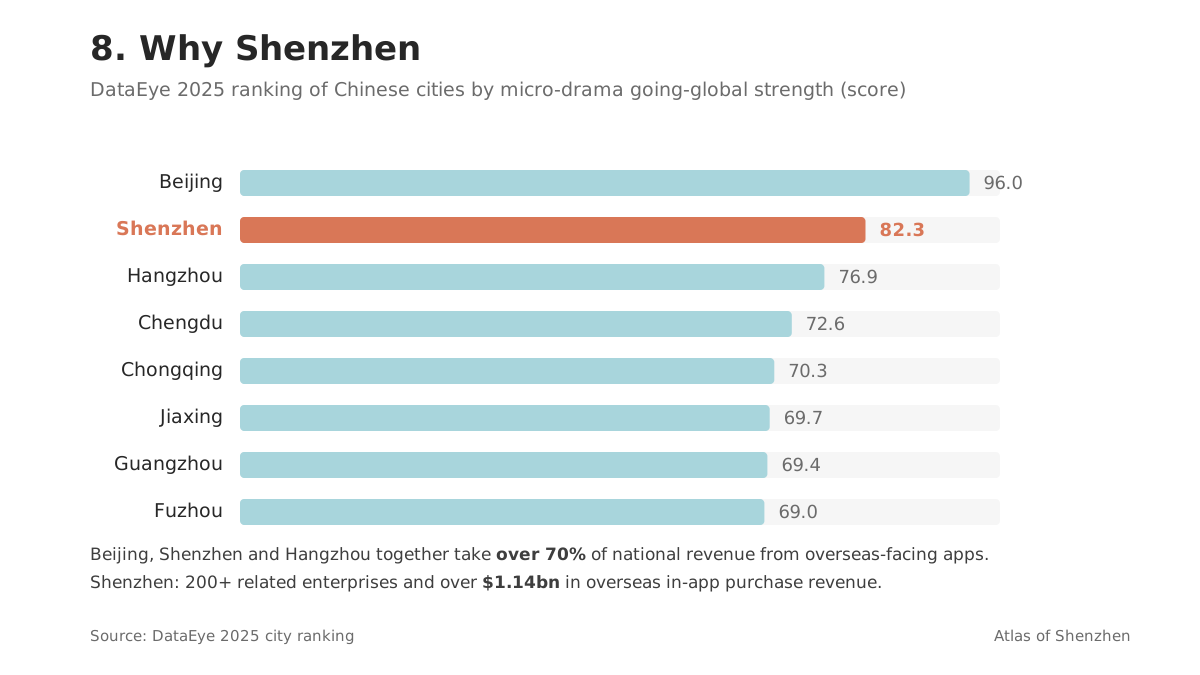
On DataEye's 2025 ranking of Chinese cities by micro-drama going-global strength, Beijing leads at 96, Shenzhen is second at 82.3, followed by Hangzhou at 76.9, Chengdu at 72.6, Chongqing at 70.3, Jiaxing at 69.7, Guangzhou at 69.4, Fuzhou at 69, Nanjing at 68.8, and Nanning at 68. Beijing, Shenzhen, and Hangzhou together account for more than 70% of national revenue from overseas-facing apps. Shenzhen ranks second nationally in going-global capacity and fourth overall, with more than 200 related enterprises and over $1.14 billion in overseas in-app purchase revenue.
Policy has followed the market. On 2 September 2026, the Global Short-Drama Film and Television Industry Going-Global Base was unveiled in Bao'an District, inside the Shenshiying AI Film and Television Industry City. It is structured around three pillars — AI short-drama going global, an OPC creator community, and IP digital-asset going global — and its 2026–2030 plan integrates industrialised AI production, a creator platform, an order marketplace, going-global distribution, and IP incubation. Bao'an itself hosts more than 7,400 national high-tech enterprises and 92 listed companies.
The city's support programme organises 11 funding directions across three categories: creative production, industry services, and cluster development, with applications filed through Guangdong's government services portal. A Futian competition offers ¥200,000 to ¥5 million per qualifying project and pairs entrants with platform mentors and a one-stop going-global service desk covering cross-border settlement, overseas legal compliance, and multilingual localisation.
9. What to watch
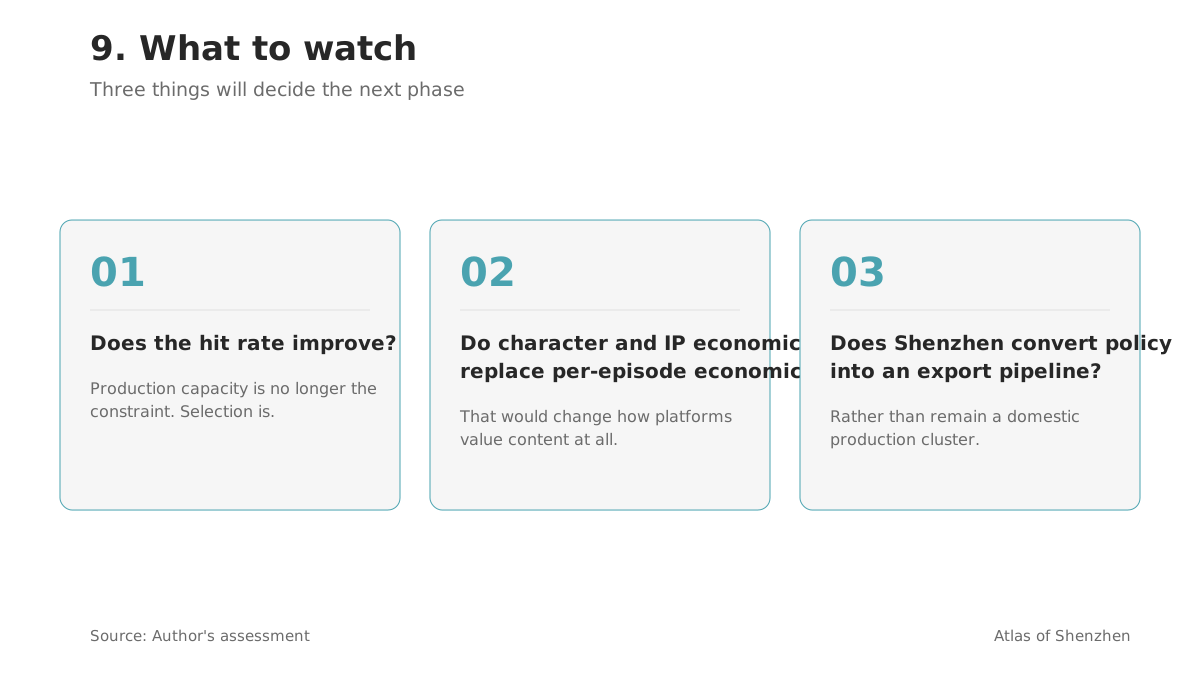
Three things will decide the next phase. First, whether the hit rate improves: production capacity is no longer the constraint, selection is. Second, whether character and IP economics replace per-episode economics, which would change how platforms value content at all. Third, whether Shenzhen converts its policy head start into an export pipeline rather than a domestic production cluster.
The 36-second cadence will not slow down. The question is whether anything inside it is worth remembering.
Sources: compiled from public industry reporting, brokerage research and official institutional releases, September 2026. Figures as reported by DataEye, QuestMobile, People's Daily, Securities Times, Jiemian News, Caixin and municipal government publications.